Inquiry intake and quoting.
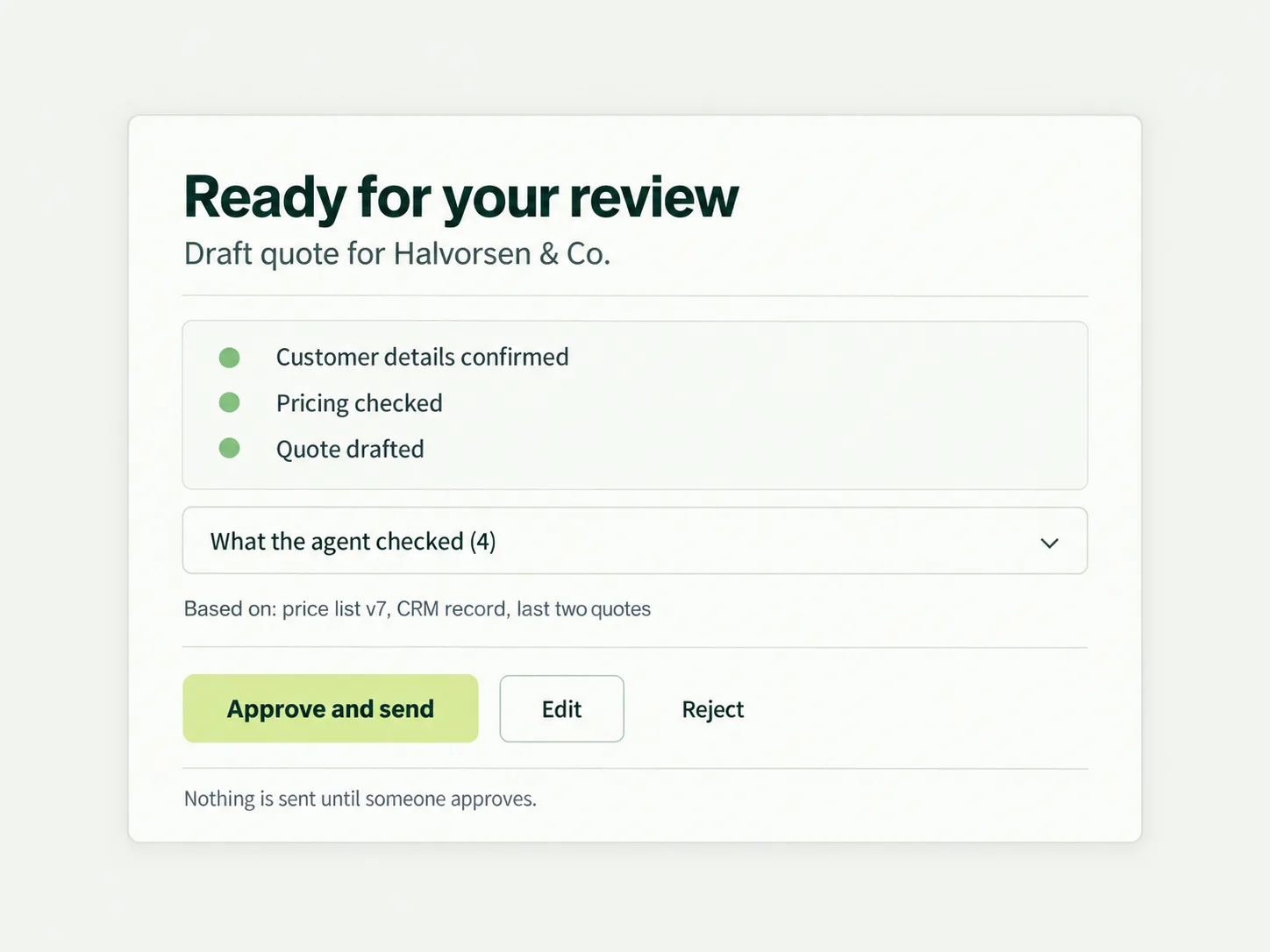
AI drafts a CRM record and a quote from a new lead email for your team to approve.
For small and mid-market companies · Atlanta · Nationwide
We find where your team loses time, build AI into the software you already use to handle that work, and keep it running. The AI prepares the work, and your team approves the actions that affect money, records or customers.
Most of this work sits between the systems you already pay for: your CRM, your accounting software and your inbox.
AI drafts a CRM record and a quote from a new lead email for your team to approve.
AI drafts answers to repeat questions from information you approve. A person handles anything sensitive.
AI matches invoices to purchase orders and checks onboarding packets for anything missing.
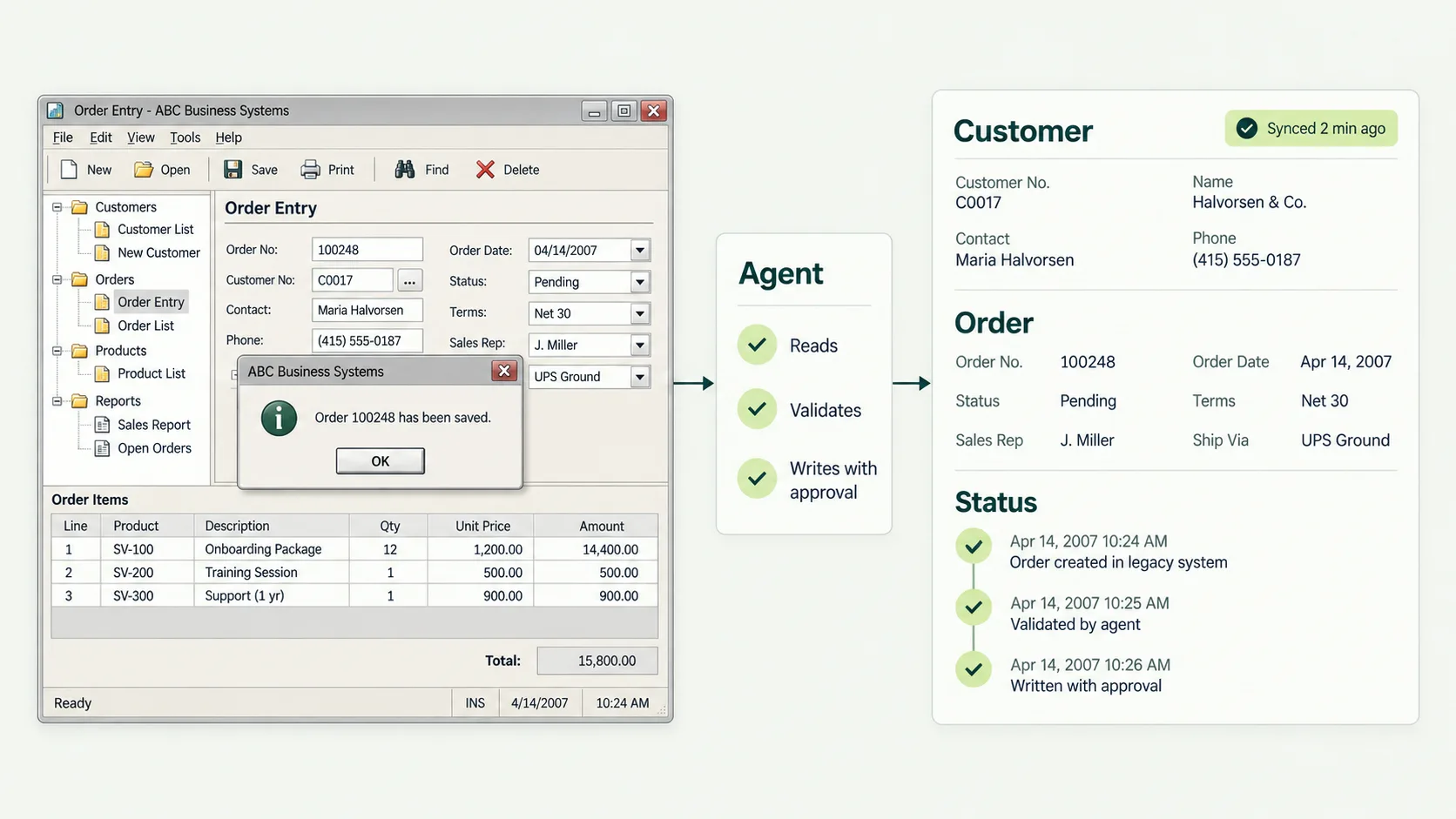
Your staff enter information once. AI checks it and, after your team's approval, copies it into your CRM, accounting and project tools.
Open proposals, unpaid invoices and stalled deals get a drafted follow-up and a reminder.
Your weekly numbers from three systems in one report, with each figure linked to its source.
First drafts built from your own past work, in your voice, for a person to finish.
A summary of a prospect, a vendor or a regulation, ready before the meeting.
If your task is not on this list, bring it to the call. The audit shows whether AI can do it.
In 2025, MIT researchers reported that about 95% of company generative-AI pilots showed no measurable return. The pattern is familiar: the tool works in the demo, nobody owns it, it fails on the first unusual case, and the team goes back to the spreadsheet.
We measure the work before we recommend a build. Sometimes we recommend not building at all.
Each build gets its own written scope, its own price and your approval.
Every workflow goes live with a named person responsible for it, on your team or ours, a queue for the cases it cannot handle, and someone watching it.
Source: MIT NANDA, The GenAI Divide: State of AI in Business 2025.
Tell us what your company does and where your team loses time. We will tell you whether an audit is worth paying for.
We measure the work with the people who do it. You get a ranked list of what to automate, with the estimated savings and the math shown. You keep the report whether or not you hire us to build.
from $2,500.We build one workflow at a time, each at a fixed scope and price. Then we run it for you, or hand it to your team.
You may still need to. The audit shows which part of the job software can handle, so the person you hire spends time on the part that needs judgment.
These tools work for one person's inbox. Across a CRM, an accounting system and a help desk, they break more easily, and nobody owns them when they do. That is usually when companies call us.
Those tools connect two apps well when one event should trigger another. When the work means reading a document, drafting a reply or handling an unusual case, you need AI with clear limits that someone has tested.
A large firm will write you a strategy. We measure your workload, build the first workflow and stay to run it, at prices we publish on this site.
That is reasonable if you know what the manual work costs you today. The audit is the lowest-cost way to find out.
Audits start at $2,500. Builds start at $9,000, with a fixed scope and price. Ongoing management starts at $1,250 a month. Everything is scoped in writing before you pay.
See pricingChatGPT asks your team to change how they work. We build AI into the tools they already use every day, so the work arrives as a draft for them to review.
That is common. The audit shows which workflows can run on the data you have now and which need cleanup first. We do not start with a data cleanup project unless the numbers justify it.
Every build comes with a queue for the cases it cannot handle, a way to pause it, and a named person responsible for it. If we run it for you, we watch it. If your team runs it, we show them how at handoff.
You do. Once you pay, the custom work and its documentation are yours. Passwords and access keys stay in your systems.
No. Your CRM, accounting system and inbox stay. We connect to what you have and tell you up front if an older system limits what we can do.
Yes. We use open-weight AI models that can run on hardware you own or in a cloud account only you control. See on-premise private AI.
The work runs in your accounts, under permissions you grant, with passwords and access keys kept in your systems. If we use a cloud AI provider, we choose it with you based on the sensitivity of the work and tell you which one we use. For work that cannot leave your control, we use private AI instead. We do not use your data to train anything. See how we handle your data.
An audit measures workflows in one to six teams and picks the first build. A roadmap sets direction across the whole company and defines the work for the first three builds. We help you choose on the free call.
The first call is free. We ask a few questions and tell you whether an audit is worth it for your company.